Last modified 5 weeks ago Last modified on 22/12/11 17:42:03

Latest news

InterMine 0.98 release

InterMine 0.98 is now available. New features include:

  • Human readable labels
  • Automatic userprofile porting
  • Expanded region search

Please see the ReleaseNotes for the complete list of new features.

  • Posted: 2011-10-04 15:48 (Updated: 2011-10-04 15:48)
  • Author: julie
  • Categories: (none)
  • Comments (0)

Renewed InterMine & MOD funding

An NHGRI grant that funded a collaboration between  InterMine and three of the major Model Organism Databases (MODs) has been renewed and expanded.

The new InterMOD funding is for three years and now includes  MGI (mouse) and  WormBase (worm) who will each set up and host an InterMine instance. These will work alongsi ...

(Read more)

  • Posted: 2011-09-21 11:48
  • Author: rns
  • Categories: (none)
  • Comments (0)

InterMine

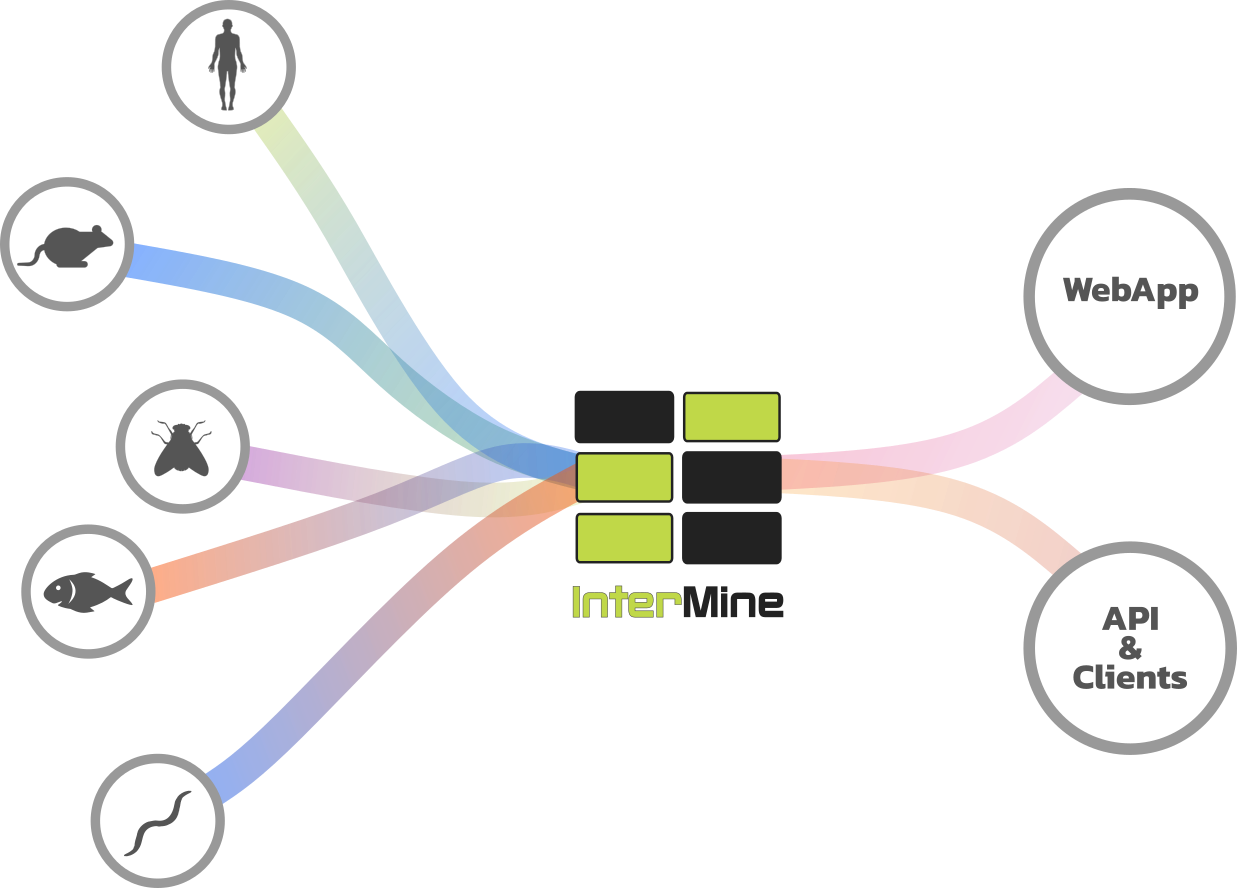
InterMine is a powerful open source data warehouse system. Using InterMine, you can create databases of biological data accessed by sophisticated web query tools. Parsers are provided for integrating data from many common biological data sources and formats, and there is a framework for adding your own data. InterMine includes an attractive, user-friendly web interface that works 'out of the box' and can be easily customised for your specific needs, as well as a powerful, scriptable web-service API to allow programmatic access to your data.

The InterMine data warehouse system has a number of attractive features including supporting:

  • efficient construction and querying of large databases (largest production database currently >0.5TB)
  • export of data in a variety of configurable/common formats
  • generating, uploading and working with lists of genes and providing embedded tools with which to characterise them. e.g. finding publications that mention an unexpectedly large number of genes in a list, or finding enriched Gene Ontology terms.
  • private workspaces for users to save their own custom search queries and lists.
  • RESTful API and client libraries for programmatic access to data - connect your website to an InterMine, or automate complex data-based workflows.
  • configuration of much of the user interface by biologist super-users rather than developers
  • a core data model that can easily be extended as new data types are added
  • transparent use of pre-computed tables, allowing performance tuning of an otherwise normal schema
  • automatic derivation of entire system including database, Java classes and web application from the data model, allowing simple and error-free upgrading of user interface and API as the data model is adjusted and new types of data are added.

All InterMine code is freely available under the LGPL license. See checkout information.

Find out more - What is InterMine?

Powered by InterMine:

Current version 0.98. See instructions for upgrading to 0.98. Release notes here.

Start here

GettingStarted
Guide to setting up and running InterMine
WebServiceQuickStart
Web Service Usage Examples
Get the software
Check out the source code
MailingList
Join the mailing list and view message archive

Documentation

DataIntegration
About loading and integrating data in InterMine
Web application
Configuring and using the web application
Web services
How to use InterMine web services
Perl Client Library
How to use the Perl client library
Python Client Library
How to use the Python client library
Java Client Library
How to use the Java client library
JavaScript Client Library
How to use the JavaScript client library
CoreTechnical
Technical reference documents
FAQs
 JavaDoc
Java API documentation
Python API
Python API documentation
InterMine talks and workshops
Set up a FlyMine mirror
and integrate your own data

Contact Us

MailingList
Join the development mailing list
ContactUs

InterMine is actively developed by the  FlyMine &  Cambridge UK ModENCODE Teams at the  Cambridge Systems Biology Centre. FlyMine and InterMine are funded by the  Wellcome Trust.

Logo credit

The InterMine logo was designed by  Sean O'Connell as part of the  GMOD Logo Program with  Linn-Benton Community College.